
If you’ve ever heard someone say “I’m an RMO” and thought …cool, but what does that actually mean?
Australian hospitals are pretty consistent in how roles are structured, but the job titles can vary slightly by state (and even by hospital). Here’s a clear guide to what each level means and what hiring teams are usually looking for.
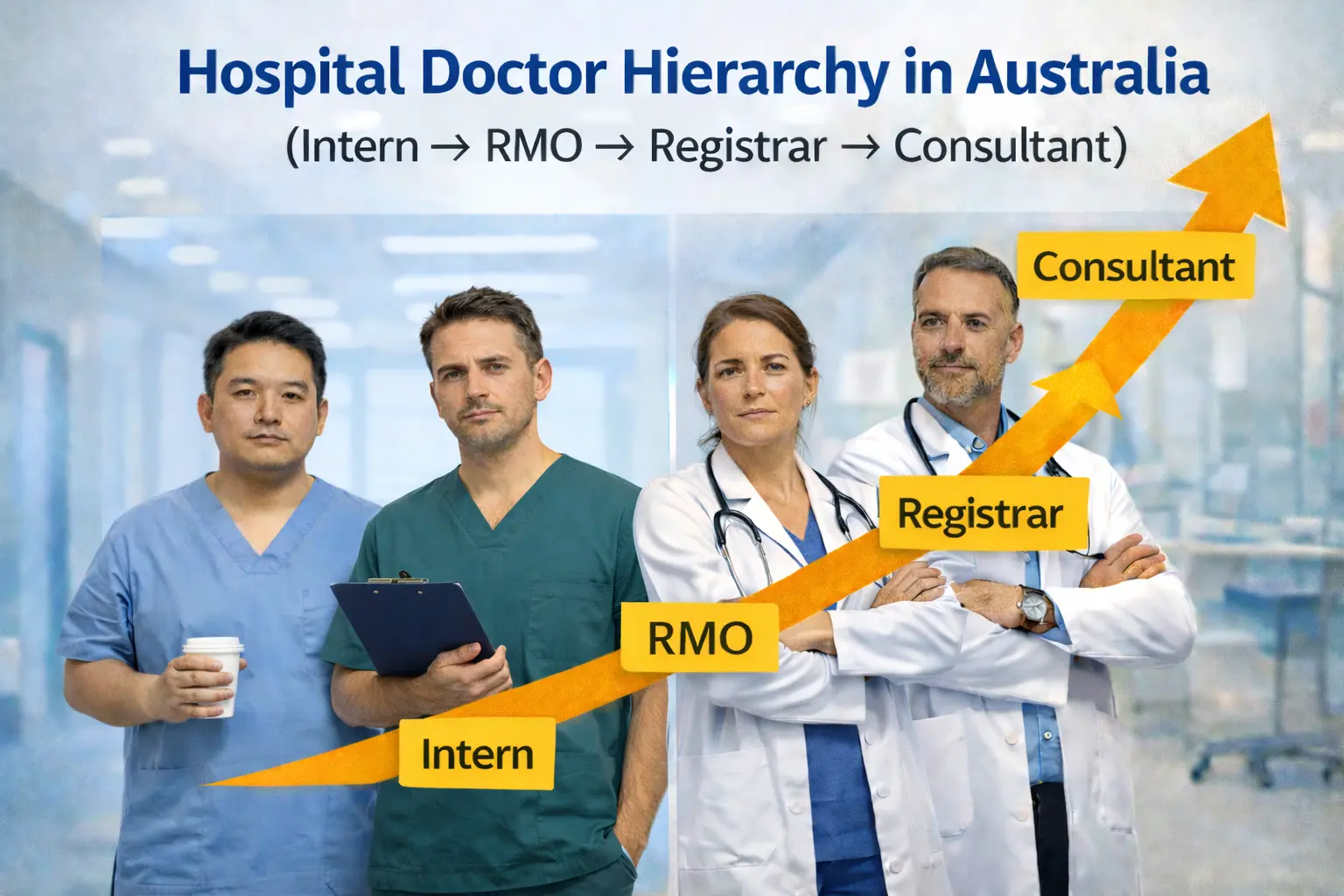
The quick version (doctor ladder)
Most hospital doctor roles sit in this order:
- Intern (PGY1)
- Resident / RMO / HMO (usually PGY2–3)
- Senior Resident / SRMO / PHO (varies by state)
- Registrar (unaccredited or accredited trainee)
- Fellow / Senior Registrar (common in some specialties)
- Consultant / Staff Specialist / VMO
Intern (PGY1): “Supervised, structured, learning hard”
This is your first year after medical school, usually via an intern training program.
Typical intern work:
- ward jobs (orders, plans, discharge summaries)
- basic procedures (depending on term)
- referrals + chasing results
- learning hospital systems
Registration note: Interns usually hold provisional registration and transition to general registration after completing internship requirements.
Resident / RMO / HMO (PGY2+): “More independence, still supported”
This is the stage where you’re commonly called:
- RMO (Resident Medical Officer) in most states
- HMO in (Victoria)
What you’ll do as an RMO/HMO:
- manage patients day-to-day on the wards
- cover after-hours shifts (nights/weekends depending on roster)
- escalate clinical concerns appropriately
- build speed + confidence with documentation and prioritisation
Hiring teams love RMO/HMOs who:
- are safe and escalate early when needed
- communicate clearly (especially with nursing + allied health)
- write clean, timely notes
- are reliable on roster and handover
SRMO / PHO: “Bridging into registrar level”
You’ll see titles like:
- SRMO (Senior Resident Medical Officer)
- PHO (Principal House Officer — common in QLD)
- “Senior HMO” (some networks)
These roles often mean:
- more leadership in the team
- heavier after-hours responsibility
- stepping closer to registrar expectations
If you’re aiming for training later, this is a really strategic year to build a CV that “makes sense”.
Registrar: “Now you’re running the show (with consultant backup)”
Registrar roles come in a few flavours:
1. Unaccredited registrar
You’re working at registrar level, but not in a formal college training spot (yet).
2. Accredited trainee (on a college program)
You’re officially in a training pathway (requirements depend on specialty/college).
3. Service registrar
Role is primarily service-driven (can still be great experience – just be clear whether it counts toward training).
Typical registrar responsibilities:
- managing referrals and triage
- leading junior staff day-to-day
- complex decision-making + escalation
- supervising interns/RMOs
- planning discharges and coordinating care
Fellow / Senior Registrar: “Polishing skills before consultant”
Common in:
- physician specialties
- ED subspecialty areas
- ICU
- some surgical subspecialties
Often includes:
- advanced clinical scope
- teaching/leadership
- audits/research
- readiness for independent specialist practice
Consultant / Staff Specialist / VMO: “Final clinical decision-maker”
This is the senior role – the person who signs off management plans and carries ultimate responsibility.
Terminology can vary:
- Staff Specialist (common in public hospitals)
- VMO (Visiting Medical Officer, often in private or mixed models)
Helpful official links
- Medical Board of Australia: Interns + requirements (medicalboard.gov.au)
- Medical Board: Provisional → General registration process (medicalboard.gov.au)
- Medical Board: Types of medical registration (medicalboard.gov.au)
- AHPRA: Applying for registration (AHPRA)
- AHPRA: International practitioners info (AHPRA)
- Queensland Health: Medical career structure (Careers)
- NSW Health: JMO glossary (titles explained) (NSW Health)
AMA: Pathways in Medicine (RMO/registrar overview) (Australian Medical Association)