
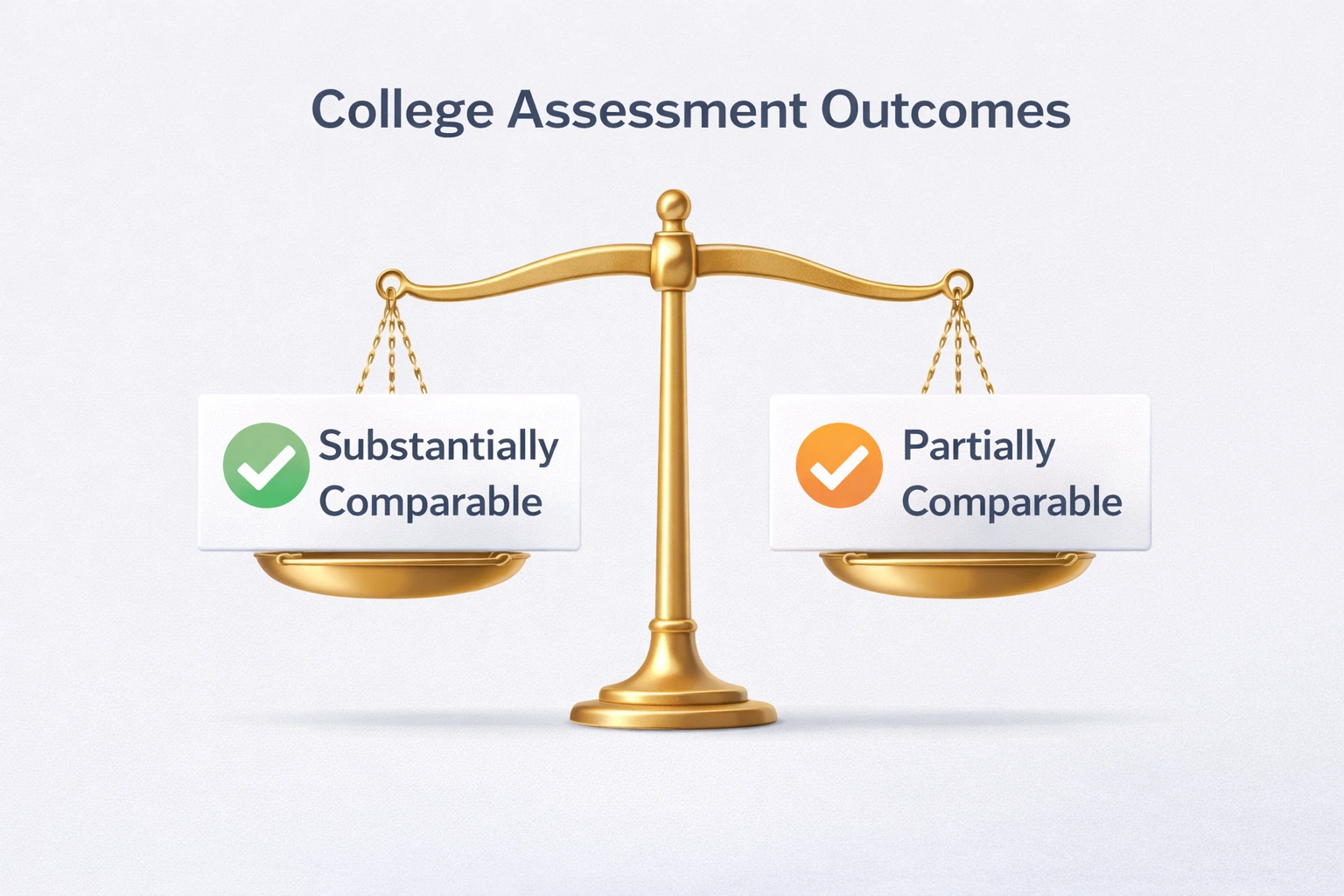
If you’re an overseas-trained specialist applying to work in Australia via the Specialist Pathway (SIMG), there are two phrases you’ll almost certainly hear after your college assessment:
- Substantially Comparable (SC)
- Partially Comparable (PC)
They sound similar but they are not the same in practice and depending on which one you receive, your job options, supervision needs, and timelines can look very different.
1. What does Substantially Comparable really mean?
Being assessed as Substantially Comparable generally means the college considers you to be at a level similar to an Australian-trained specialist who’s just starting independent practice.
You’re almost there — but not quite finished yet.
Under the national Specialist Pathway guidance, substantially comparable doctors are usually required to complete up to 12 months FTE of supervised practice or peer review under a college-approved supervisor.
What this usually looks like in real life
- You may work in a very senior role, sometimes with consultant-level duties.
- You still have peer review or supervision, even if day-to-day work feels quite independent.
- The focus isn’t clinical skills alone — it’s about:
- practising safely in the Australian system
- understanding local guidelines and escalation culture
- documentation, communication, and governance expectations
- Once you complete the peer review successfully, you can progress toward specialist registration.
Think of SC as:
“You’re trusted — now show us you can do it safely in the Australian context.”
2. What does Partially Comparable mean?
Partially Comparable means the college believes you can practise safely within a defined scope, but you still need more time, supervision, and often top-up training before you’re equivalent to an Australian-trained specialist.
Under Specialist Pathway guidance, partially comparable doctors may need up to 24 months FTE of supervised practice.
What this usually looks like in real life
- You’re not yet suitable for fully independent consultant roles.
- You’ll usually target:
- registrar or senior registrar roles
- DMO or fellow positions
- Your job must:
- match your defined scope of practice
- allow you to complete any required assessments or training
- meet college and Medical Board requirements
Think of PC as:
“You’re safe and capable — now let’s build you up to full comparability.”
3. The tricky part – securing a suitable position
It takes time and it may be harder then you think!
Even if you’re assessed as SC or PC, you still need to secure a suitable position to progress through the pathway and “suitable” doesn’t just mean any job that looks interesting.
In practice, it means:
- the hospital or service can provide a college-approved supervisor
- the role clearly matches your scope and outcome
- there’s proper governance, reporting, and oversight
- the position genuinely supports your Specialist Pathway requirements
This is where many applications fall over — not because the doctor isn’t strong, but because the role doesn’t actually meet pathway criteria.
4. How to show your SC/PC outcome on your CV (so decision-makers don’t miss it)
If you’re on the Specialist Pathway, this information should be impossible to miss.
Option A: a simple “Quick Status” box (very effective)
Quick status
- Specialty: General Medicine (Physician)
- College assessment: Substantially Comparable (issued Aug 2025)
- Requirement: Peer review / supervised practice (12 months FTE)
- Registration goal: Specialist registration on completion
- Availability: 8 weeks
Option B: one-line banner under your name
College assessment outcome: Substantially Comparable — peer review required (decision date: Aug 2025)
If you’re Partially Comparable, be just as clear:
Quick status
- College assessment: Partially Comparable (issued Aug 2025)
- Requirements: Supervised practice 24 months/ top-up training 12 months
- Seeking: Senior registrar or fellow role with approved supervision
Also add your pathway right next to it:
- Specialist Pathway (SIMG) — college assessment complete; seeking approved supervised practice role.
Clarity = faster decisions.
5. What hospitals are actually thinking when they see SC or PC
Most hospitals aren’t asking, “Is this person good?”
They’re asking:
“Can we support this doctor safely and compliantly?”
They usually want to know:
- Who will supervise you (and are they college-approved)?
- Does the role match your assessed scope?
- Can they meet reporting and assessment requirements?
- Is this considered a “suitable position” under the Specialist Pathway?
6. Choosing the right roles for your outcome
If you’re Substantially Comparable
You’ll usually want roles that:
- reflect senior or specialist capability
- still offer peer review or supervision
- have clear governance and approved supervision
Often a good fit:
- staff specialist roles with peer review
- senior fellow or senior registrar posts
- structured area-of-need specialist roles (depending on specialty)
If you’re Partially Comparable
You’ll usually want roles that:
- are clearly designed for supervised practice
- align with your defined scope
- support any required assessments or training
Often a good fit:
- registrar/senior registrar or fellow roles
- service roles aligned to your college plan
- rotational roles targeting gap areas
Usually avoid:
- roles expecting fully independent consultant practice without the supervision structure you need
7. A quick “do this now” checklist
Update your CV
- Put SC/PC outcome, college, and date at the top of page 1
- Add your pathway (Specialist Pathway / GP comparability, etc.)
- Include a short line explaining supervision requirements
Make it easy to read
- Spellcheck and grammar check
- Consistent formatting
- Plenty of white space
Apply smarter
- Focus on roles that can actually support your pathway. If you are not sure speak to experienced medical recruiter at Mediix Recruitment: inquiry@mediix.com.au