
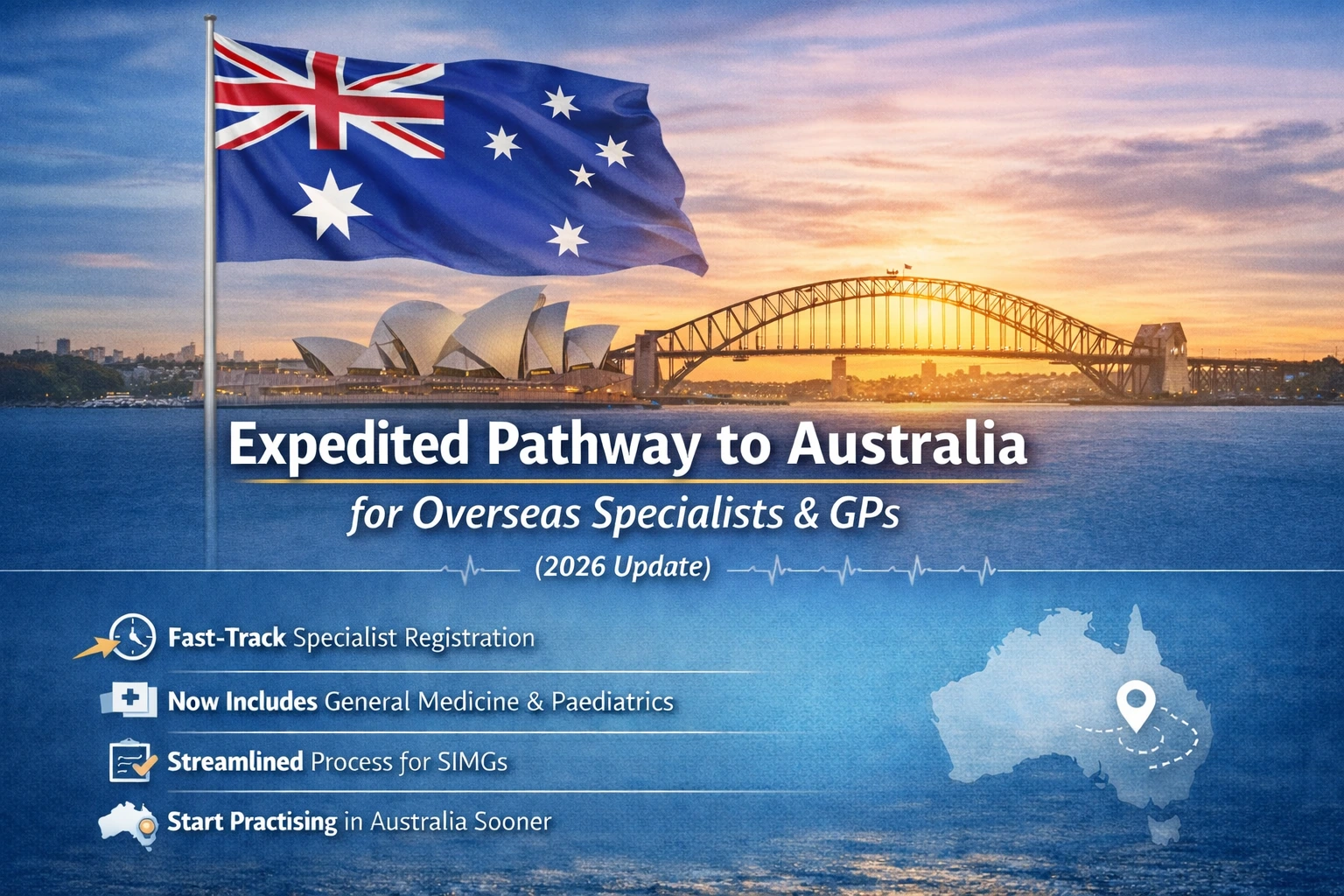
If you’re an overseas-trained doctor thinking about relocating to Australia — especially as a GP or specialist — there’s good news: the Expedited Specialist Pathway is now open and helping highly qualified international medical graduates fast-track registration and begin practising sooner.
This initiative reflects Australia’s urgent need for medical professionals while still maintaining high standards of patient safety and clinical competence.
Let’s break down what this pathway is all about, who it’s for, and how it works in a friendly, practical way.
Why the Expedited Pathway Exists
Australia’s health system continues to face significant workforce shortages, particularly in rural and regional settings.
To help address these gaps, the Expedited Specialist Pathway was introduced as a streamlined route for qualified overseas doctors to gain specialist registration with the Medical Board of Australia.
The aim isn’t to cut corners — it’s to reduce red tape and unnecessary delays while still making sure doctors are safe, capable, and ready to work in the Australian system.
Who Is Eligible?
You may be eligible if:
✔ You are a Specialist International Medical Graduate (SIMG)
✔ You have a specialist medical qualification that is recognised on the Medical Board’s Expedited Specialist Pathway accepted qualifications list
✔ Your primary medical qualification is recognised by the Australian Medical Council (AMC) and the World Directory of Medical Schools
Here’s a summary of the qualifications accepted for eligibility in the Expedited Specialist Pathway, based on the official Medical Board of Australia list (as at early 2026):
1. General Practice
United Kingdom
- Membership of the Royal College of General Practitioners (MRCGP) plus
- Certificate of Completion of Training (CCT) from GMC or PMETB
(training under an approved UK GP specialist program since August 2007)
Ireland
- Membership of the Irish College of General Practitioners (MICGP) plus
- Certificate of Satisfactory Completion of Specialist Training (CSCST)
(under an accredited Irish GP program since 2009)
New Zealand
- Fellowship of the Royal New Zealand College of General Practitioners (FRNZCGP)
(awarded under the General Practice Education Programme – GPEP)
These qualifications must meet the Board’s requirements and include evidence of completion of recognised GP specialist training.
2. Anaesthesia
Ireland
- Fellowship of the College of Anaesthesiologists of Ireland (FCAI) plus
- Certificate of Satisfactory Completion of Specialist Training (CSCST)
(from an approved Irish anaesthesia program since July 2012)
United Kingdom
- Fellowship of the Royal College of Anaesthetists (FRCA) plus
- Certificate of Completion of Training (CCT)
(from an approved UK training program since August 2007)
Additional requirement: completion of an Effective Management of Anaesthetic Crisis (EMAC) course, as recommended by the Australian and New Zealand College of Anaesthetists, may be required.
3. Obstetrics & Gynaecology
Ireland
- Membership of the Royal College of Physicians of Ireland (MRCPI) plus
- Certificate of Satisfactory Completion of Specialist Training (CSCST)
(in obstetrics & gynaecology from an accredited Irish programme since July 2010) - Includes evidence of relevant examinations
United Kingdom
- Membership of the Royal College of Obstetricians and Gynaecologists (MRCOG) plus
- Certificate of Completion of Training (CCT)
(from an approved UK programme since August 2007)
Additional procedural requirements (e.g. colposcopy training) may be needed for full Australian practice.
4. Psychiatry
United Kingdom
- Membership of the Royal College of Psychiatrists (MRCPsych) plus
- Certificate of Completion of Training (CCT)
(awarded under any MRCPsych-approved curriculum from August 2007 to date, following satisfactory completion of a GMC- or PMETB-approved psychiatric specialist training programme)
This means UK-trained psychiatrists with MRCPsych + CCT are currently eligible for the Expedited Specialist Pathway.
Psychiatrists trained outside the UK must still go through standard specialist assessment with the Royal Australian and New Zealand College of Psychiatrists unless their qualification appears on the Board’s accepted list.
5. General Medicine
Ireland
- Fellowship / Membership of the Royal College of Physicians of Ireland (RCPI) plus
- Certificate of Satisfactory Completion of Specialist Training (CSCST)
(in General Internal Medicine from an accredited Irish physician training programme)
Includes evidence of completion of all required examinations and recognised specialist training.
United Kingdom
- Membership of the Royal Colleges of Physicians of the United Kingdom (MRCP(UK)) plus
- Certificate of Completion of Training (CCT)
(in General Internal Medicine from a GMC-approved UK training programme)
Applicants must demonstrate completion of recognised General Medicine specialist training consistent with Australian scope of practice.
6. Paediatrics (General Paediatrics)
Ireland
- Membership of the Royal College of Physicians of Ireland (MRCPI Paediatrics) plus
- Certificate of Satisfactory Completion of Specialist Training (CSCST)
(in Paediatrics from an accredited Irish paediatric training programme)
Includes evidence of relevant paediatric examinations and completion of recognised specialist training.
United Kingdom
- Membership of the Royal College of Paediatrics and Child Health (MRCPCH) plus
- Certificate of Completion of Training (CCT)
(in Paediatrics from a GMC-approved UK training programme)
Scope of practice is General Paediatrics. Subspecialty practice may require additional credentialing or assessment in Australia.
How the Expedited Pathway Really Works
The pathway is designed to be faster and more direct than traditional specialist pathways. Here’s a simplified overview of the process:
1. Primary Source Verification
Your medical degrees and qualifications must be verified through the AMC/EPIC system — just like other IMG pathways.
2. Check the Approved Qualification List
Confirm your specialist qualification is on the Medical Board’s Expedited Specialist Pathway list before applying.
3. Apply to the Medical Board
You submit your application directly for specialist registration through AHPRA / the Medical Board — no need for lengthy specialist college comparability assessments first.
4. Supervised Practice
Once granted conditional specialist registration, you must complete six months of supervised practice in Australia. This includes:
- Supervised clinical work
- Orientation to the Australian healthcare system
- Cultural safety education
- Workplace-based assessments (Mini-CEX, DOPS, or case-based discussion)
5. Conditions Removed
After meeting all requirements, you apply to the Board to have conditions removed and continue practice independently as a fully registered specialist.
Why This Pathway Matters
For overseas doctors, the traditional specialist registration process could take many months — sometimes over a year — before you can actually work clinically.
The expedited pathway significantly shortens that timeline by removing redundant steps while still ensuring quality and safety.
It’s especially meaningful if:
- You want to relocate and work in Australia as soon as possible
- You have strong international qualifications from recognised training systems
- You’re interested in working in specialist or general practice roles right away
Important Things to Keep in Mind
✔ You still need verified qualifications and supervised practice — this isn’t a shortcut to bypass competency checks
✔ It doesn’t automatically grant fellowship with an Australian specialist college — you can pursue fellowship separately
✔ Not all specialties are on the list yet — eligibility continues to expand based on workforce needs
Is It Worth Pursuing?
Absolutely – yes, for eligible doctors.
The expedited pathway is a game-changer for internationally trained GPs and specialists looking to work in Australia.
Reach out to our team at Mediix for personalised guidance and current opportunities across Australia: Inquiry@mediix.com.au